The origins of your favorite symbol?

Every wonder about the origins of your favorite mathematical symbol?  Did someone find it under a rock?  Was it someone’s idea of a cruel joke?  Well, wonder no more.  Thanks to Douglas Weaver and Anthony D. Smith from Taperoo High School (Australia), you can now learn the origins of many of the mathematical world’s favorite symbols.

To begin the fun, click here:  http://www.roma.unisa.edu.au/07305/symbols.htm#Index

Google honors Fermat!

Kudos to Google!

Anyone who loves math knows how rare it is for mainstream society to be exposed to mathematics of any kind.  However, yesterday, Google exposed tens of millions of people to one of the most famous mathematicians of all time, Pierre Fermat.  To honor his 4o1st birthday on August 17, Google created the Doodle seen above.  What is the Doodle about?  Well, written on the chalkboard is what is known as Fermat’s Last Theorem.  Simply put, the theorem states that the equation x^n+y^n=z^n has no integer solutions for n>2 and x,y,z ≠ 0.

However, what has become more famous than the actual theorem is the mystery Fermat left behind.  The theorem, discovered after his death and written in the margin of his copy of Arithmetica, included the note  “I have discovered a truly marvelous demonstration of this proposition that this margin is too narrow to contain.”

For the next three centuries, legendary mathematicians tried hopelessly to recreate the proof that Fermat claimed he had discovered.  Finally, in 1993, the mathematician Andrew Wiles (with a little help from others to fill in some gaps) found a proof.  Beyond putting the mystery to rest, Wiles put to rest the idea that Fermat ever had a legitimate proof of the theorem as the mathematics he used had only been developed in the 20th century.

So, if Fermat never left a proof, then why call it a theorem?  Any high school geometry student will tell you that a theorem requires a proof.  It all has to do with the fame of the person making the claim.  Fermat was about as famous as any mathematician could be and was, therefore, given the benefit of the doubt.  Unfortunately, for us mere mortals it would have been called a conjecture and, more importantly, lost to the sands of time.

L’Hospital’s Rule? … think again!

March 17 celebrates the anniversary of one of the most lopsided business deals in mathematical history.  Before the days of companies and colleges employing mathematicians, one of the few ways for a mathematician to earn money was to be employed by a nobleman.  You might earn your keep by tutoring, consulting on finances, surveying the lands or anything else involving numbers.

In the late 17th century, the great mathematician Johann Bernoulli was looking for a way to earn money while doing what he loved, mathematics.  Enter the Marquis de L’Hospital.  L’Hospital was a nobleman who was fascinated by mathematics, particularly calculus, which was in its infancy at the time.  And he knew that Johann had worked with Gottfried Leibniz with the development of calculus.

However, unlike the great ones, L’Hospital lacked the skill necessary to understand the finer points of this new field of calculus.  So, he had an idea.  If he hired Bernoulli as a sort of mathematical consultant, Bernoulli would be available to help L’Hospital with any difficulties he might encounter.

So, on March 17, 1694, The Marquis de L’Hospital and Johann Bernoulli entered a financial relationship in which L’Hospital would pay Bernoulli an annual salary to be available as a mathematical consultant.  Bernoulli would answer any questions L’Hospital might have and, here’s the big one, send any new mathematical discoveries directly to L’Hospital without announcing these discoveries to the world.  Basically, L’Hospital believed that he should have some sort of ownership over Bernoulli’s ideas since it was he who was paying Bernoulli to research mathematics.  In other words, any great breakthroughs would be credited to L’Hospital instead of Bernoulli.  Sound strange?  It was.  But remember the times.  It was almost impossible to get a paying job as a mathematician.  So Bernoulli saw this as his only opportunity to earn a living as a mathematician.

What was the result of this arrangement?  One of the first books in calculus … Analyse des infiniment petits … written by … wait for it … L’Hospital!  Included in the book were many of Bernoulli’s ideas.  However, since L’Hospital was the author, he was viewed as the mathematician who made the discoveries.

Now, L’Hospital knew full well that he was essentially ‘stealing’ the ideas of other mathematicians so he included the following statement in the book:  “I have made free use of their discoveries, so that I frankly return to them whatever they please to claim as their own.”  As history will show, his book became quite popular.  In fact, one of the most famous and important ideas from the book became known as L’Hospital’s Rule … a great rule for evaluating limits when the limit yields the indeterminant form 0/0 … known by calculus students worldwide!  Poor Bernoulli.

If you are interested in reading more about this scandal and many others, there is a great book on the subject … Mathematical Scandals by Theoni Pappas.  Included on pages 16 – 21 is a more detailed account of the scandal involving L’Hospital’s Rule.

Has anyone seen Einstein’s Pen?

People who know me know that I have an unhealthy obsession with pens and pencils.  And, when it comes to pens, I love fountain pens.  There is just something about them, classic and traditional … a high quality writing instrument in the age of keyboards and touchscreens.

So it should be no surprise to anyone that I decided to begin a quest to discover what kind of fountain pen Albert Einstein used during his glory years of scientific discovery.  The pen of choice for most people in the late 19th and early 20th Centuries was the fountain pen.  Today, a fountain pen is seen more as a luxury than a necessity, but back then, the fountain pen was the workhorse of anyone using a pen.  So, when I decided to find out more about this pen, I first visited the Fountain Pen Network (FPN).  This is a bulletin board dedicated to talking about all things fountain pens … it is one of my favorite sites!

My search began when I learned that the FPN has an entire discussion on the topic of Einstein’s pen!  The discussion revolves around this picture of Einstein becoming a U.S. citizen in 1940.  Notice the pen in his jacket pocket …

After much discussion on the site, most people came to the conclusion that it is either a Pelikan 100 N or a 100 C.  (To read the entire debate, click here.)

So, I guess that’s it.  The easiest quest ever, right?  Not so fast.  This photo is from 1940, and despite it being Einstein’s pen, it is very unlikely the pen that Einstein used to develop his most famous theories.  And, let’s face it.  It would be so much cooler to see that one.

So … as I continued to read the threads, I found my next clue.  Someone posted that Einstein gave away his most famous pen, the pen that he used to develop the Theory of Relativity, to Paul Ehrenfest in 1921.  Now we’re getting somewhere.  Included in the post is a link to an article about this pen.  (It is written in Dutch and required a Google translation for me to understand it!  See the translation here.)  According to the imperfect translation, Ehrenfest states “This pen has been used for years and by Einstein at least the period from 1912 to 1921 – so all his designs and calculations on the general theory of relativity and gravitation in this period were written with this pen. He gave me this in 1921.”   Even better than the article was a picture of the pen!  So, here it is:
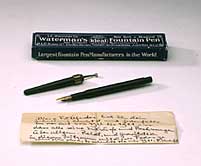
According to the FPN, it is a Waterman Taper-cap.  Have I mentioned how much I love the FPN?!?

So, finally, my quest ends.  Right?  Not really.  This is certainly the pen that he used but, look at the picture.  It’s so small.  I just wasn’t happy with it.  I really needed to see this pen close up.  So I had no choice but to continue my quest.

Finally, after hours of searching, I came across a video tour of the Boerhaave Museum in Leiden where the pen is currently located.  As I watched the video, understanding none of it (it is in Dutch after all), I saw it.  There it was.  The docent pulled it out of the vault and placed it on the table.  I was blown away.  Such a simple and unassuming pen.  This is the pen that helped Einstein to redefine the Universe as we know it.  It was an amazing moment.  Below is a screenshot of the pen from the video.  Enjoy!

Well, there you have it, Einstein’s pen … or at least one of them … at least the one that he used to write his most important work.  What’s next, you ask?  I wonder what pencils he liked to use.

Creative Wallpaper?

Saturday Jan. 15th 2011 will mark the 161st birthday of Sofia Kovalevskaya.  While many of you may not recognize the name, Sofia is considered the greatest female mathematician, pre-20th Century.  And, like many of my students, you may be wondering how one “grows” into such a great mathematician.  It turns out that, in Sofia’s case, it takes some good interior design.

Like the “dream child” of any parent, Sofia had an early interest in math (thanks in part to her uncle.)  However, it wasn’t until the age of 11 that this interest really took off.  It was at this age that her family decided to decorate the walls of her bedroom with the lecture notes from a course in differential and integral calculus that her father had taken years earlier.  By staring at the wallpaper and getting lost in the beautiful equations, Sofia was able to make connections between it and the things that her uncle had told her.  The wallpaper offered her a portal into the world of calculus!

According to her autobiography, “The meaning of these concepts I naturally could not yet grasp, but they acted on my imagination, instilling in me a reverence for mathematics as an exalted and mysterious science which opens up to its initiates a new world of wonders, inaccessible to ordinary mortals.

Moral of the story:  teenagers everywhere, tear down those ridiculous “Glee” posters and put up those math notes!  You’ll be glad you did!