One “long” multiplication problem … revisited

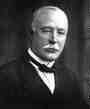
Frank Nelson Cole

Here’s a simple question for you – What are the factors of 147,573,952,589,676,412,927?  Impossible?  Well, before you run off and find your calculator, would it help to mention that someone found its factors using only a pencil and paper?  It’s true.  On October 31, 1903, Frank Cole did just that.  He factored the number 147,573,952,589,676,412,927 – with just a pencil and paper!

What makes the story so legendary is the way Cole revealed the factors.  At a meeting of the American Mathematical Society, Cole presented his paper titled “On the factoring of large numbers.”  Usually, when a mathematician presents a paper, he or she stands on a stage in front of a blackboard, lecturing to the audience about the particular topic of their paper.  However, Cole’s lecture was different.  He did not speak a single word.  He simply went to the board, and began to calculate.  On one side of the board, he calculated 267 – 1 = 147,573,952,589,676,412,927 by hand.  Then he went to the other side of the board and worked out the product of 193,707,721 and 761,838,257,287, the factors of 147,573,952,589,676,412,927.  After spending the silent hour working out the calculations, Cole simply turned around and went back to his seat, completely silent!  The audience erupted into a standing ovation.  Talk about making a dramatic presentation!  Later, when asked how long it took him to find the factors, he responded by saying “three years of Sundays.”

So, why would anyone in their right mind take the time to factor such a big number you ask?  Why this one?  Why the number 267 – 1?  It turns out that this number is related to something known as Mersenne Primes.  First popularized by the French monk Marin Mersenne, primes of this form are generated using the formula 2p − 1 (where p is prime).  For example:  if p = 2, then 2– 1 = 3 or if p = 5, then 2– 1 = 31.  And, as you know, both 5 and 31 are prime numbers.

I know what you are thinking – I thought it was impossible to have a formula that generates primes.  Well, yes and no.  While there is no formula that will generate ALL prime numbers, there are many formulas that generate some primes.  Unfortunately, as with all prime formulas, even this formula doesn’t always work.  For example, if p = 11, then 211 – 1 = 2047.  2047 is a composite number with factors 23 and 89.

So, why bother with a formula that inconsistently generates primes?  Well, mathematicians are fun people.  And, like most people, they are attracted to big things – like big prime numbers.  Since this formula can generate some pretty massive numbers, the potential for monstrous size prime numbers exists.  And, what’s better than massive prime numbers?  Nothing!  In fact, some mathematicians are so obsessed with really big primes that they have started an internet search for big primes called GIMPS –  the Great Internet Mersenne Prime Search.  If you go to this website, you can download a program to help out with the search!  To date, there have been 47 Mersenne Primes discovered.  The biggest, discovered on April 12, 2011, is a 12,837,064 digit number.  (Click here to see the number.)

Like many of the massive numbers generated by Mersenne’s formula, 267 – 1 had the potential to be prime.  However, no one was sure because there are no effective techniques for factoring large numbers.  Finally, in 1876, Edouard Lucas made the first breakthrough by proving that this number could not be prime.  However, he was unable to find its factors.  Well, there is no greater enticement to a mathematician than a good mystery.  So, the search began.  And, thanks to Frank Cole, the mystery was solved on October 31, 1903.

For someone like me, a triumph like this, in the age of technology, should be celebrated!  Well done!
Finally … a museum dedicated to math!

Well, it’s been a long time coming.  In a country that has museums dedicated to SPAM®, funerals and hobos, we finally have one dedicated to something much more interesting … mathematics!

Opening on 12/15/12 in New York City, the Museum of Mathematics will offer “dynamic exhibits and programs [that] will stimulate inquiry, spark curiosity, and reveal the wonders of mathematics. The museum’s activities will lead a broad and diverse audience to understand the evolving, creative, human, and aesthetic nature of mathematics.”

If you are interested in learning more about the museum or its founder, check out one of these websites:

I hope you get a chance to check it out!

Kaprekar … one more time!

Following up on my previous post titled “A surprising result …” involving Kaprekar’s Operation, I thought I would offer one more interesting result from the Indian mathematician D. R. Kaprekar.  So let’s talk about a Kaprekar Number.

What’s a Kaprekar number?  Take an n-digit number k. Square it and add the right n digits to the left n or n-1 digits. If the resultant sum is k, then k is called a Kaprekar number.  Oh, is that all?  I thought it was going to be something complicated to understand!

Let me show you by example.

  • Take the number 45.  This means that k = 45.  Since it is a 2 digit number we have n = 2.
  • Square it.  Now we have 2025.  The right 2 digits are 25 and the left 2 digits are 20.  (Remember n = 2.)
  • If you look at the sum of 20 and 25 you get 45.
  • So we call 45 a Kaprekar number.

Let’s try a second example.

  • Take the number 297.  This means that  k = 297.  Since it is a 3 digit number we have n = 3.
  • Square it.  Now we have 88209.  The right 3 digits are 209 and left 2 digits (remember n or n-1) are 88.
  • If you look at the sum of 209 and 88 you get 297.
  • So we call 297 a Kaprekar number.

Amazing, isn’t it?  Can you think of any other Kaprekar Numbers?  There are plenty of them out there in the great mathematical universe.

If you are interested in reading more about the theory behind Kaprekar Numbers, you can look at the paper titled “The Kaprekar Numbers” by Douglas E. Iannucci published in the Journal of Integer Sequences.

(Thanks to MathWorld for the official definition of a Kaprekar Number:  Weisstein, Eric W. “Kaprekar Number.” From MathWorld–A Wolfram Web Resource. http://mathworld.wolfram.com/KaprekarNumber.html)

A surprising result …

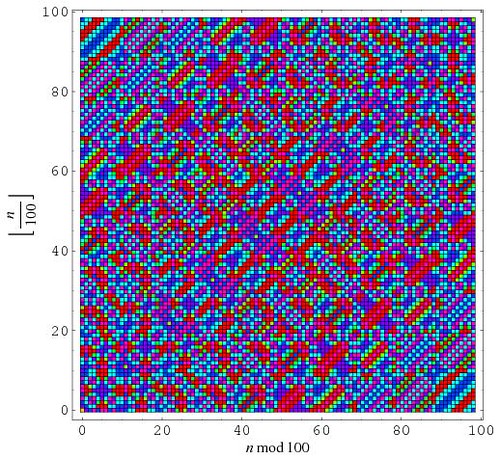
Gorgeous graph, isn’t it?
Deutsch, D. and Goldman, B. (2004)

Here’s a fun little math problem to start off your school year …

  1. Take any four digit number where all the digits are not the same.
  2. Next, rearrange the digits so as to create the largest and smallest numbers possible.
  3. Then subtract these numbers:  largest – smallest.
  4. Continue to repeat the process with each new number until you get stuck (reach a fixed point).  You’ll know when it happens!

Is the algorithm confusing?  Let me start you off with an example.  I will stop before the surprise!

  1. Take the number 4573 (Again, you don’t want a number where all the digits are the same, e.g. 5555)
  2. Rearrange the digits for the largest:  7543 and smallest:  3457
  3. Subtract:  7543 – 3457 = 4086
  4. Repeat the process with 4086:  8640 – 0468 = 8172 … 8721 – 1278 = 7443 … get the idea?

Some things to try:

  1. Pick a different number and try the algorithm again.  Did the same thing happen?  Beautiful, isn’t it!
  2. Once you realize what happens … which four digit number gets you to the fixed point in the fewest number of iterations?
  3. For all four digit numbers … is there a maximum number of iterations to get to the fixed point?

Still looking for some fun?  Try these extensions:

  1. Try the same algorithm with any three digit number.  What happens?
  2. How about any five digit number?

This algorithm is credited to the Indian mathematician D. R. Kaprekar and is known as Kaprekar’s Routine.  (The fixed point, 6174, is sometimes called Kaprekar’s constant.)  If you are as amazed as I am and want some additional information about the mathematics involved in the algorithm, then you can click on one of the links below:

About the graph … The figure above shows the number of steps required for the Kaprekar routine to reach a fixed point for values of n = 0 to 9999, partitioned into rows of length 100. Numbers having fewer than 4 digits are padded with leading 0s, thus resulting in all values converging to 6174.  Image: Deutsch, D. and Goldman, B. (2004). Kaprekar’s Constant. Mathematics Teacher 98: 234-242.  Click here for the link:  Kaprekar’s Constant

Welcome to Musings on Math!

“A mathematician is a device which turns coffee into theorems.”

– Alfréd Rényi

Hello.  Welcome to musingsonmath.com!  My goal when creating this website was to give my high school and college math students a place to go to learn more about the information I presented in class – ideas that we didn’t have time for during the confines of our class time (not necessarily the technical aspects of the class, textbooks do an O.K. job of that).  Rather, what I wanted was a place to go where the more human side of the subject could be explored: the people and events that shaped the thinking and understanding of the mathematicians who discovered (or created) the beautiful world of mathematics.   That doesn’t mean that I don’t ever delve into the mathematics.  I do, from time to time, offer up some more technical posts as well as some more interesting problems to solve.  However, I want this site to show that mathematics is not some technical, dry and emotionally void subject that is written in a complicated and cold language.  Instead, it is a subject that is a lively and colorful, full of interesting characters and fascinating stories that make mathematics into a living, breathing subject to be enjoyed by all.  So, whatever your reason for visiting this site, I hope you enjoy it and learn from it.

Before I leave you to your explorations, just a few last points …

The Navigation Bars:

  • The top menu bar contains my website pages.  On these pages, you can find all sorts of mathematical links, articles, problems, books, gift ideas, etc.
  • The bottom menu bar contains the categories of my posts.

My Top 5 most visited pages and posts:

One last item … new posts can always be found below this Welcome post and to the right listed under “Recent Posts.”

Please feel free to contact me with your suggestions, additions or advice by leaving a comment or sending me an email at musingsonmath@gmail.com.

You can also read some new posts on Twitter:  @musingsonmath

Or you can also follow the site on Twitter:


Enjoy the site!