The sounds of Pi

Ever wonder what Pi would sound like if it were played on musical instruments?  Well, here it is … the musical interpretation of Pi to 31 decimal places or 3.1415926535897932384626433832795.  I always knew that mathematics was visually beautiful, but I never imaged how beautiful it could sound.  Just breathtaking!  (Thanks to the musician Michael John Blake for taking the time to create it and to my colleague for finding the link for me.)

Click here to enjoy:  http://www.newscientist.com/blogs/nstv/2011/03/a-musical-interpretation-of-pi.html

I wonder what the number e would sound like?

The World’s Hardest Easy Geometry Problem

Every once in a while a math problem takes the world by storm … at least the world of nerds.  About five years ago, the “World’s Hardest Easy Geometry Problem” hit the internet.  Not that this problem was new or unique.  After all, it has been around for hundreds of years.  However, with the speed and ease of communication of the internet, the problem spread like wildfire.  In fact, according to rumors, the problem was so addictive that the whiteboards in the offices of Google were filled with attempted solutions.  As the story goes, one employee said that the problem probably cost Google about a quarter of a million dollars in lost time.

What was the problem that people couldn’t stop thinking about?  Think you can solve it?  Enjoy … and no cheating!  (For a PDF version of the problem, click World’s Hardest Easy Geometry Problem.)


Did the Wizard cheat the Scarecrow?

It’s that time of year – the time of year I start talking about right triangles and the world-famous Pythagorean Theorem.  And, what discussion of the Pythagorean Theorem would be complete without telling my students about one the most important blunders in the “mathematical history” of Hollywood?

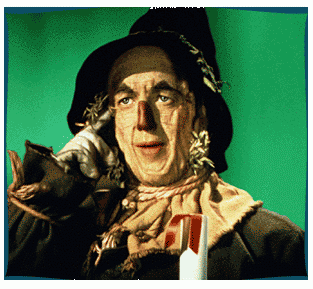
For those of you who may not know what I am talking about, you have to go back to 1939, to one of the most popular movies of all time, The Wizard of Oz.  If you remember the end of the movie, then you remember when the Scarecrow finally gets what he always wanted, a brain.  He is so excited to use his new brain, he decides to recite the Pythagorean Theorem.  The problem is he gets it wrong, completely wrong.  Below is his infamous statement:

Please don't say it!

“The sum of the square roots of any two sides of an isosceles triangle is equal to the square root of the remaining side.”

Hmm … is he even trying to state the Pythagorean Theorem?  Because, if he isn’t, he was cheated far worse than I thought!

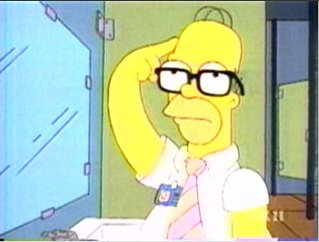
Not to be outdone by the Scarecrow, Homer Simpson repeats the infamous line in an episode of The Simpsons after finding a pair of glasses in a toilet.  No sooner does he state it then someone tells him that it is for “a right triangle, you idiot!”  While this is closer to the real thing, it still isn’t quite there.
Not again!

A few weeks ago, I wrote about how much I like “pseudo math” – the kind that looks like it is somehow important but, in reality, is nothing more than random mathematical symbols on the screen or page.  Well, here is a classic example of just that.  And, as I said before, I will take any kind of math, real or otherwise, as long as people are being exposed to it.

I love “pseudo” math!

What is “pseudo” math, you ask?  It’s what I like to call the kind of math you see in movies, magazine advertisements and on TV – the kind that looks like it is somehow important but, in reality, is nothing more than random mathematical symbols on the screen or page.  For instance, take a look  at John Berman’s report (ABC News) looking at the math behind the numbers of the GOP race for the Republican Presidential nomination – Close Up This Week.

I love the algebra, the formulas, the symbols, his use of the terms calculus, algebra, and theorem.  It is, of course, meaningless but that doesn’t matter to me.  Just the fact that he has used these words is enough to excite me.  Any time the media or Hollywood celebrates math and gets it out into the public is a victory in my book!

Thanks, John!

A theorem a day in the New Year

Looking for that perfect New Year’s resolution?  Looking for something that will be both informative and fun to do each day?  I give you the best resolution ever – reading about a different theorem every day in the New Year!

Below is a great website that publishes a different theorem each day for you to read and enjoy.  Honestly, can you think of anything better to do with your time?  That’s more of a rhetorical question as we all know the answer is NO!

To get started, just click on the website:  http://www.theoremoftheday.org/index.php.  Happy New Year!